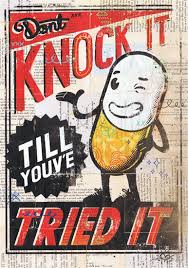
Don't Knock It Till You've Tried It - Sam Bevington
Artist Analysis: Sam Bevington
Born
in 1987, Sam graduated from UWE in Bristol in First Class Honours in
2009. His work is heavily influenced by urban surroundings and
environment and graphic illustrations of the 1930s-1940s.
Most
of Bevingtons work is made using graphic design programmes featuring
typography and the 1930s looking illustrations, his illustrations
also can sometimes be controversial and touch upon taboo subjects.
As
his artistic career has only just started, Bevington has already
designed posters and other advertisements for company's like 3 Mobile
and The NHS.
This
piece here is called Don't Knock it Till You've Tried it. The piece
looks like a poster for something but is drawn on top of book pages
as it is a poster it makes you read it from top to bottom, the look
at the image. The piece is all worn and faded but features a
character that looks like a medicinal pill but done in a 1930s style,
so maybe the piece is made to look worn to make it seem like it id
from that time. The poster also has the words Don't Knock It Till
You've Tried it written on it, this saying implies that this pill may
be for recreational use and shows the controversy that Bevington
sometimes features. In the piece there are colourful and childlike
drawing done in what looks like crayons. The colours used in the
piece are mostly primary colour (Blue, red and yellow) this again may
suggest childlike qualities.
I
believe that this piece is created to show how old fashioned saying,
with good intent can be used for more controversial issues and more
sinister situations, for example the drug use that is suggested in
the piece.
This
piece influences me as I like the way he has made a child friendly
looking poster into something that children should not be taught. I
also appreciate the way that he has turned the traditional saying of
"don't knock it till you've tried it." into almost an
advert for people to try drugs.
